
Eggs – How To Cook Eggs – Egg Recipes
Learn the basic essentials on how to cook eggs. We also provide helpful egg nutritional information, egg hints and tips and many great egg recipes!
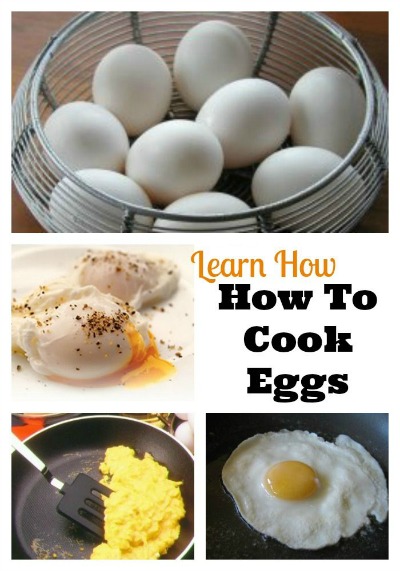
Egg Cooking Recipes and Techniques:
Baked (Shirred) Eggs
In France, this basic methods of baked eggs is called oeufs en cocotte.
Boiling Eggs
According to the American Egg Board, the terms “hard-boiled” and “soft-boiled” eggs are really misnomers, because boiling eggs makes them tough and rubbery. Instead, these eggs should be “hard-” or “soft-cooked” in hot (still) water.
Coddled Eggs
Coddled eggs are made by very briefly immersing an egg in the shell in boiling water (to cook in water just below the boiling point) to slightly cook or coddle them.
Deviled Eggs
Deviled eggs have their roots in ancient Roman recipes with the first published recipes for stuffed, boiled eggs were from medieval Europe. In the 17th century, this was a common way to prepare eggs. They were not called “deviled” until the 18th Century, in England.
Fried Eggs – Perfect Fried Egg
Learn how to cook eggs in the French technique that very slowly fries the eggs in butter.
Microwave Eggs
Learn how to cook eggs in the microwave – poached eggs, fried eggs, scrambled eggs, and boiled eggs.
Poached Eggs
The best eggs for poaching are the freshest eggs you can find. If eggs are more than a week old, the whites thin out. Whites of fresh eggs will gather compactly around the yolk, making a rounder, neater shape.
Scrambled Eggs/Omelets
Scrambled eggs make a delicious and quick meal, but there is a little science to getting them just right. The secret to successfully scrambling eggs is slow cooking (you need low, gentle heat).
Misc. Egg Information:
Egg Equivalents – The correct egg size can be important in recipes with exacting measurement requirements, such as cakes. At other times it doesn’t matter.
Eggs Whites vs. Whole Eggs
It seems that whole eggs have a long history of being both good for you, then bad for you (during the low cholesterol craze), and then good for you again. Almost every day, you hear this age-old myth: Whole eggs are bad for you because they contain too much cholesterol and fat.
How Fresh Are Your Eggs?
Date Codes on Egg Cartons
Coloring Eggs:
Making Natural Easter Egg Dyes
Tea Infused Eggs
(Marbleized Eggs)
Questions & Answers:
How to test if an egg is fresh:
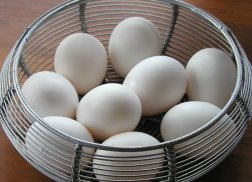 Firstly, fill a deep bowl with water and carefully lower the egg into the water. A very fresh egg will immediately sink to the bottom and lie flat on its side. This is because the air cell within the egg is very small. The egg should also feel quite heavy. As the egg starts to lose its freshness and more air enters the egg, it will begin to float and stand upright. The smaller end will lie on the bottom of the bowl, whilst the broader end will point towards the surface. The egg will still be good enough to consume, however, if the egg fully floats in the water and does not touch the bottom of the bowl at all, it should be discarded, as it will most likely be bad.
The second method to test the eggs freshness is by breaking the egg onto a flat plate, not into a bowl. The yolk of a very fresh egg will have a round and compact appearance and it will sit positioned quite high up in the middle of the egg. The white that surrounds it will be thick and stays close to the yolk. A less fresh egg will contain a flatter yolk, that may break easily and a thinner white that spreads quite far over the plate.
Does Egg Size Matter?
Eggs are sold in a range of standard sizes, the most common being jumbo, extra large, large, and medium. Check out Egg Equivalents Large eggs are used in most recipes. Chicken eggs are most commonly used. In some areas, duck, goose, and quail eggs are also available. Shell color-brown or white-is purely superficial; there is no difference in quality. Refrigerate in the carton for up to 5 weeks.
Egg Storage:
Eggs are a perishable food and need to be refrigerated. Keep eggs in the original carton in the coldest part of your refrigerator. Throw away any eggs that are cracked, broken, or leaking. It is best not to wash eggs before storing or using them. Washing is a routine part of commercial egg processing and the eggs do not need to be rewashed.
Fresh eggs in the shell – 3 to 4 weeks
Fresh egg whites – 2 to 4 days
Fresh egg yolks (unbroken and covered with water) – 2 to 4 days
Hard-cooked eggs – 1 week
Deviled eggs – 2 to 3 days
Leftover egg dishes – 3 to 4 days
What is Chalazae? (kuh-LAY-zee)
Ropey strands of egg white which anchor the yolk in place in the center of the thick white. There are two chalazae anchoring each yolk, on opposite ends of the egg. They are neither imperfections nor beginning embryos. The more prominent the chalazae, the fresher the egg. Chalazae does not interfere with the cooking or beating of the white and need not be removed, although some cooks like to strain them from stirred custard.
How To Tell a Raw Egg from a Hard Boiled Egg:
If you hold up two (2) eggs and one is hard-boiled and the other is raw, you might wonder how to know which is which. A simple test will reveal the answer. Spin them carefully on a countertop. The hard-boiled one spins and the raw one doesn’t. This is because the hard-boiled egg is solid so everything spins in one direction, while the inside of the raw egg sloshes in different directions and, therefore, doesn’t allow it to spin. Try it and see for yourself.
Serving Egg Dishes:
Important: If you are taking deviled eggs, egg salad or other egg-based foods to a picnic or outdoor event, pack them with ice or a commercial coolant in an insulated bag or cooler to keep them cold. When entertaining, serve all egg dishes within two hours. Cold egg dishes and beverages should be kept on ice. Serve eggs and egg-rich foods immediately after cooking or refrigerate and use within 3 to 4 days.
Nutritional Value of Eggs:
 Eggs make a valuable contribution to a healthy, balanced diet. Eggs provide protein, vitamin A, riboflavin, and other vitamins and minerals. The yolk contains all the fat, saturated fat, and cholesterol in an egg. Eggs are an excellent source of high-quality protein and are far less expensive than most other animal-protein foods. Although eggs contain a significant amount of cholesterol, they need not be excluded from the diet. Most people need not be concerned about eating eggs in moderation.
Categories:
Breakfast Egg Entrees Cooking Lessons - Cooking 101 Egg Hints and Tips Egg Recipes Egg Recipes
2 Responses to “How To Cook Eggs”
JULIE BERRIER
what do you call it when you cook eggs in boiling water instead of oil or butter.
Linda Stradley
Are you talking about poaching eggs?