
Spain, Italy, and California are the largest growers and producers of olive oil, with more olive oil grown in Spain than in any other country. What is the difference between Spanish olive oil, Italian olive oil, and California olive oil? Spanish and California olive oil is golden and yellow in color with a fruity, nutty flavor. Italian olive oil is green to dark green in color with an herbal, grassy flavor.
Olive oil should have a fruity olive flavor that is characteristic of the variety or blend of varieties making up the oil. There should be no vinegary or fermented odor or flavor. The oil should also not be rancid or possess any other off flavor that is essentially not of the olive.
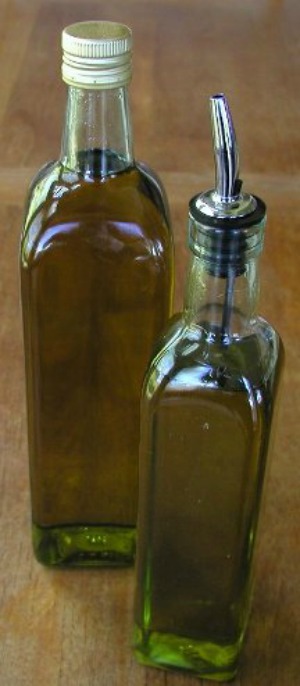 How To Buy and Store Olive Oil:
Purchasing Olive Oil: Buying oil in small sizes, or splitting larger bottles with friends, is a practical way to buy expensive olive oils. Olive oil purchased in bulk should always be poured into smaller containers, preferably in a can or a dark-colored bottle.
Do not pay much attention to the color of an olive oil. Good olive oils will come in all shades, from vivid green to gold to pale straw. Official tasters actually use colored glasses to avoid prejudicing themselves in favor of greener oils.
Remember – Olives are fruit, a stone fruit like cherries and plums – olive oil is a fresh-squeezed fruit juice. Unlike many wines, which improve with age, extra virgin olive oil is perishable and does not improve with age. Olive oil, like all natural fruit juices, its flavor and aroma begin to deteriorate within a few months of milling. This decline accelerates when the olive oil is bottled, and really speeds up when the bottle is opened.
Rancid Olive Oil: Air, heat, and light will cause olive oil to turn rancid (rancid is the flavor which is imparted in an oil after it has undergone the process of oxidation. Since prolonged contact with oxygen is the rot cause of oxidation, rancidity is a common defect, so it should be stored in a cool place in an airtight container). If your oil has a buttery taste, then it’s probably rancid.
Ideal Storing Temperature: The ideal temperature for storing olive oil is 57 degrees F. or 14 degrees C, although a normal room temperature of 70 degrees F. works very well if the olive oil is stored in a dark area where the temperature remains fairly constant. A kitchen cabinet located away from the stove and away from direct sunlight will work quite well. If you have a wine cellar, store your olive oils there and keep a small amount in your kitchen. Do not put olive oil in a container without a tight cap.
Refrigeration: Refrigeration does not harm most grades of olive oil, but it is not recommended for expensive extra virgin varieties because condensation may develop in the bottle, affecting the flavor. When chilled, or in cold weather, the oil may turn cloudy and even solidify. Such oil will clear again as it warms, so cloudiness should not be taken as an indication that the oil is past its prime. Refrigeration will extend the life of olive oil without harming the oil. Doing so will cause it to congeal and turn cloudy, but should not affect flavor. If refrigerated, olive oil will return to its original, liquid state when warmed to room temperature again. Refrigeration does not harm most grades of olive oil, but it is not recommended.
Bottles: Be sure olive oil bottles are tightly sealed. Tinted glass, porcelain, or stainless steel are the best materials for containers; oil should never be stored in plastic or in reactive metals. Stay away from plastic containers as the oil can absorb PVCs.
What does first pressing and cold pressing mean? These terms are interchangeable and have been used in the past when initial pressure applied by hand presses produced only a small amount of olive oil from olive paste. To extract even more oil, hot water was applied to the olive paste to improve the flow of oil. This is where the terms cold pressing and first pressing came from.
Producers use these terms on their labeling to affirm that extra virgin olive oil is an unrefined, natural product that has undergone very little processing.
Types of Olive Oil – Not all Olive Oils are the same:
When you shop at a supermarket or gourmet food store, you will usually find a fairly good selection of good-quality olive oils. Unfortunately, many of the oils on the shelves are “boutique” oils in attractive and small bottles. They probably have artistic, designer labels – both from the U.S. and from Spain and Italy.
So, how do you choose a good Spanish olive oil? Well, reading the label is important, as well as knowing what is important and what is not, since many pieces of information on the label is marketing hype. Just like fine wine, the flavor, color, and consistency of olive oils vary. This is due to different olive varieties, location, and weather. The olive oils of some small producers are treated and priced just like fine vintage wines.
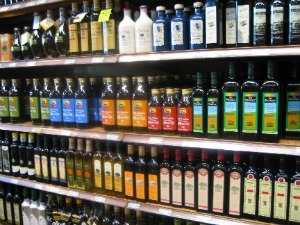
Extra-Virgin Olive Oil: This is the good stuff, with flavor characteristics of fresh, crisp, clean, fruity olive oil. Extra virgin oils do not have any off flavors or any flavors of cooked or refined oil. They feel substantial in the mouth and are not greasy. All olive extra-virgin olive oils that are less than 1% acidity and produced by the first pressing of the olive fruit through the cold pressing process is called extra-virgin olive oil.
Virgin Olive Oil: Labeled as olive oil or pure olive oil or light olive oil. This is the mediocre stuff that is usually just bland. It is made from olives that are slightly riper than those used in the production of extra-virgin oil. Virgin olive oil is produced in the same way, but it is essentially defective or low-grade extra virgin oil. This oil’s acidity is a slightly higher level of 1 1/2%.
Pure Olive Oil: Pure olive oil, usually called just olive oil, comes either from the second cold pressing or the chemical extraction of the olive mash left over after the first pressing. This grade is also called commercial grade oil. Pure olive oil is much lighter in color and blander in taste than virgin olive oil. It is a general-purpose (all-purpose) olive oil. Pure refers to the fact that no non-olive oils are mixed in.
Refined Olive Oil: Olive oil known as “refined olive oil” is made by refining the virgin olive oil. The final product is basically a tasteless olive oil. The acidity level is higher than 3.3%. It also has a not-to-nice flavor and an unpleasant odor.
Pomace Oil: The not-very-good-at-all stuff, from solvent extraction of the fermented milling waste. It is usually quite bland in flavor. It goes through the same refining process as refined olive oil. It just had an even worse origin. It usually has a greasy feel in the mouth and possibly a slight cooked taste. Olive oil which consists of a blend of refined olive-pomace oil and virgin olive oil. Don’t buy this grade, as it is bad for you.
Light and Extra Light Olive Oil: The olive oil that you see on the supermarket shelf advertised as “light” or as “Extra Light” olive oil contains the exact same number of calories as regular olive oil and is a mixture of refined olive oils that are derived from the lowest quality olive oils available through chemical processing.
How To Cook with Olive Oil:
Cooking with olive oil is like cooking with wine – Never use a wine or olive oil that does not taste good to you. An inferior one will leave an aftertaste. If you do the taste test and compare the “pure” to the “extra-virgin” and the you’ll understand the difference.
Extra-Virgin Olive Oil: When cooking with olive oil, save your extra-virgin expensive oils for salads, dressings, and vinaigrettes. You can also drizzle it over slices of crusty bread or onto open-face sandwiches. Use it on a baked potato or add it to mashed potatoes instead of butter. Extra virgin olive oil tastes great on cooked vegetables or brushed onto fish or meat before serving.
Marcella Hazan who wrote the cookbook called Marcella Cucina, wrote the following:
“The taste of a dish for which you need olive oil will be as good or as ordinary as the oil you use. A sublime one can lift even modest ingredients to eminent heights of flavor; a dreary oil will pull the best ingredients down to its own level. Partial clues to the quality of the olive oil you are buying are supplied by the label and the price, but ultimately, the only way to determine which one, among those available, is right for you is to taste and compare.”
Frying: When sauteeing or frying, use either a combination olive oil (one that is simply a blend of extra virgin and regular olive oil) or a straight olive oil.
For deep frying, the olive oil grade “olive oil,” is excellent because it has a higher smoke point (410 degrees F.) than virgin or extra virgin oils.
Tasting Olive Oil – How to Taste Extra-Vigin Olive Oil:
Just as different types of grapes make different wines, different types of olives make distinct types of olive oil. The olives are also impacted by varietal of grapes, weather, soil conditions, and how handled and harvested. Just like wine, no two olive oils are created equal. Tasting olive oils allows you to discover which oils you like best, and which ones you prefer in your favorite recipes, or with your favorite bread or vegetables, The procedure for sampling and tasting olive oil is exactly like tasting wine:
Do not eat anything or have any foreign flavors in your mouth before tasting. Wait at least an hour or so after eating or drinking anything to be sure your palate is fresh. Preferably taste test olive oil in mid morning.
In professional tastings, olive oil is placed in dark blue glasses so the tasters are not influenced by the color of the oils. If you’re doing an olive oil tasting at home, you can use any small clean glasses or bowls. Use about a tablespoon of each oil.
Start by testing no more than 3 or 4 olive oils at a time,
Pour a little olive oil (approximately 1 tablespoon) in a small glass. Cover the glass with one hand, shake it delicately with the other until the oil adheres to the entire inside surface. Warm oil in the glass with your hands until it is close to body temperature.
Lift the glass to your nose (under your nose) and sniff rapidly and deeply three (3) time, raising your nose up and away from the oil between each sniff. Suck air through the oil to coax more aromas out of it, and then close your mouth and breathe out through your nose. Olive oils have aromas just like wine. We then tried to analyze the aroma. There really is a difference in aromas!
Tasting: Take a sip or slurp (approximately 10 drops into mouth). DON’T SWALLOW! Roll the olive oil around in your mouth for approximately 6 seconds and then spit it out (novices have to remember not to spit out the oil too quickly). The oil should touch all areas of the mouth so that the various tastes and sensations can be noted. Then it is spit out.
Between tasting each kind of olive oil, drink lots of water and eat a small piece of bread to cleanse your palate. No wine – just water.
Low-Stress Olive Oil Tasting:
by Paul Armas Lepisto
 Impersonal – This is the (negative) taste characteristic of olive oil which has always struck me as the most bizarre. It simply means an oil which has neither character nor personality, common in manipulated oil (oil which has undergone some sort of chemical and/or heat treatment which neutralizes flaws such as rancidness, the opposite of ‘cold-pressed’). In societies that grew up with mass-produced seed oils, such as sunflower or corn, impersonal oil is essentially the liquid oil they would come into contact with. If flavorful fats were required, then one turned to butter or lard.
The point being, you probably have a pretty good idea what impersonal oil is which gives us a good basis to build upon. Think of tofu. A neutral product which simply lends texture (and provides protein) for any number of flavorful recipes. Manipulated olive oil is similar and, the ugly fact remains, the majority of olive oil.
The good news is that it is very easy to identify a premium olive oil. When you smell it, you will have an overwhelming olive fruit aroma (with any number of other olfactory highlights which the low-stress guide will not stress you out about. You can further enhance these smells by putting some oil in a small container and warming it with your hands. Next, roll your tongue a bit and suck in a small amount of oil drawing in a good volume of air at the same time. The back-center portion of your tongue will now look for bitterness (determined by ripeness and variety of olive), a positive characteristic even if it sounds anything but. Finally, the oil goes down into your throat where you judge its pungency. If it’s particularly sharp, you might cough, but the peppery bite is proof of fresh oil with healthy olives well-processed.
All these sensations will diminish with time, so, for example, if an oil is too ‘peppery’ for you now, wait a month (even, or especially, with an unopened bottle) and it may very well have mellowed. Of course, nothing excites the olive grower more than the first oil with its strong scent and aggressive bite and a piece of bread toasted over the fire drenched in this fluid accompanied by a steak dressed with the same oil.
I have not mentioned oil color because that can be deceiving, however, one charm of fresh central Italian (Tuscany/Umbria) olive oil is its rich green color (imparted, in part, by the king of Italian olives, the Frantoio. An Umbrian might disagree considering the Moraiolo superior, but a Greek fellow might as easily argue for the Kalamata, the French gentleman, the Picholine, etc., etc.). But, nothing beats the Frantoio for a rich green color.
Oops, I just slipped into high stress olive tasting. Ignore the last three sentences. Simply look for rich, fruity smells, a bitter sensation in the middle of your mouth and a ‘peppery’ bite in the back of your throat. And, since your access to fresh super premium oil is restricted at best, even hints of those characteristics should be viewed as a gift from above despite the fact that you may very well have been sold refined, manipulated oil with a slight dose of healthy Tuscan thrown in for flavor (For example, what grocery store sells anything other than ‘extra-virgin’ even though ‘extra-virgin’ is the minority of olive oil produced. Even the next grade down, ‘virgin’, is rarely offered for sale).
But the question remains, are you using olive oil because you’ve heard that it reduces the ‘bad’ (LDL) cholesterol and does no harm to the ‘good’ (HDL), or will you pour it onto your bean soup or pasta as a condiment? For the average Italian, who uses fifteen liters of olive oil a year (in the U.S. it is 0.6 liters), it is a crucial culinary ingredient, which is one reason Italy uses more oil than it produces (and the prime oil regions of Tuscany/Umbria only produce approx. five percent of the total Italian production). Now, consider this thought for a moment; which oil would you guess they export? I would be leaning towards manipulated Tunisian . Oops, another goof. Don’t stress about labeling. Fruity, bitterness, peppery bite. And remember, if a pound of good Tuscan olives has a wholesale price of 50 cents and you need at least ten pounds for a liter of oil, tack on processing, bottling, wholesale profit, retail profit and you have to wonder what exactly is going into your Sam’s Club mega bottles of extra-virgin. Impersonal indeed.
Sources:
International Olive Council (IOC) and California Trade Standards for Olive Oil, by Paul Vosse
Photo below taken at the Hojiblanca Museum of Olive Oil in Antequera, Spain, located in Andalusia (Southern Spain). In March of 2014, What’s Cooking America ventured to Spain on a culinary trip in Andalusia. The area of Antequera, in Southern Spain, is well known as a key producer of olive oil in modern times, however the recent discovery of the ruins of a Roman villa, once dedicated to olive oil production. supports the already substantial evidence that the importance of the product in the region dates back is ancient indeed.
Its most important exhibit is a 17-century olive pressing installation, donated by the Cuadra Rojo famly. The building itself reproduces the architectural form and all the elements of the first olive pressing installation.

XVII Century Beam Press
This olive oil press is 12.5 meters long. The ropes, the nails, even the wasps’ nests are preserved.
Even though three centuries have elapsed and the timber has dried out and has been infested by termites, it still weighs 3 tons.
Questions and Answers:
The following questions have generously been answered by Paul Armas Lepisto, Director, The Olive University in Italy:
Question:
My question is about why different brands of expensive true EVOO solidify at different rates in the refrigerator. I have used several different brands of expensive true EVOO and find that they all solidify at different rates. What is the element in olive oil that is responsible for the oil solidifying when it is refrigerated? – Thank you for answering this question. – Lawrence R. Tenzer (12/11/08)
Answer:
This is a good question which I think has both a relatively simple answer and a JFK conspiracy-type answer. Simply put, while all olives varieties (to the best of my knowledge), have all three types of fats, monounsaturated (approx. 75%), polyunsaturated (10%) and saturated (15%), the levels of each vary slightly. Given that olive oil is almost always a blend of different varieties (and varieties that would vary from different regions), then you would have to assume that some olive oils would naturally have a greater percentage of saturated fats which would cause them to solidify at a different temperature.
The conspiracy theory answer is that perhaps that oil you think is extra virgin in fact has been ‘stretched’ with some other type of oil which naturally has a higher level of saturated fats. I believe they have found hazelnut oil not infrequently mixed in, for example. Not sure what the saturation level of that would
Question:
I am seventy-nine years old. When I was twenty years old to thirty-five years of age, I used to use Gem Oil in gallon cans as well as Santuzza olive oil in gallon cans. Gem oil was ten percent olive oil and Santuzza was twenty percent olive oil. Pure olive oil had an odor that would fill the whole house and had a very strong taste. The ten and twenty percent blends had plenty of flavor and odor. I lived in Syracuse New York during this time.
I now live in Lakeland Florida. I have tried various different olive oils such as Bertolli, Vigo,Pompeiian and many others that are available to us. I am sorry to have to say that they all are one hundred percent tasteless and odorless. Is there any where in this world that I can obtain a good tasting olive oil? I would rather not hear about the added tastes to olive oil such as lemon, lime, tarragon, basil etc. What I am telling you about was pure olive oil with no additives. If for some reason I cannot purchase olive oil like it used to be, so be it. I am old enough to accept that. – Thank you very much. Dominic Mercurio (9/05/08)
Answer:
A person could easily write a dissertation answering your excellent question. Fresh, true extra virgin does have a strong, distinct smell. Professional tasters often gauge an oil simply by smelling and they certainly don’t need to foul their mouths by confirming rancidity, for example, by actually tasting it.
You have your work cut out for you finding rich oils such as you remember but it is possible (albeit at a cost). And yet, compared to what you might pay for a good bottle of wine, it is a relative bargain when you consider the work that goes into producing an equivalent volume of real extra-virgin. At the risk of plugging any one oil, one that I have seen available in the U.S. which, if stored under the right conditions and bottled within the last year is Monini. It is an Umbrian producer whose owner tastes every batch before it is bottled (and like all commercial Italian oils, you can be sure it is a blend of several countries’ oils). Better would be to find smaller producers (both U.S. and abroad) on the internet and start sampling bottles until you find one you like and, perhaps more importantly, you trust. I wish I had an easier answer, but people in Italy quest for good oil, so you can imagine you are at a disadvantage in the U.S.
Question:
I enjoy reading your website forays into Olive Oil and Extra Virgin Olive Oil. Some of the information you reflect is good, however some is a bit off-base. Light Olive Oil has a completely different criteria for acidity than Extra Virgin Olive Oil. The implication that there is shady business going on with EVOO producers to manipulate acidity seems extreme. My understanding is that you can add oleic acid to the oil or use some type of chemical process to remove Oleic acid, but then it can’t be classified as Extra Virgin. The COOC and IOOC have specific criteria on what can be classified Extra Virgin and Light Olive Oil or even Olive Oil. One should probably look at those items before making some of the comparisons of Light Olive Oil to Extra Virgin or even Olive Oil products. – Crisp (3/07/08)
Answer:
It is difficult to where to start with this. Of course the name says it all about the acidity level and (light) olive oil would not be, by definition, extra-virgin, thus a different (higher) acidity level. I suppose it would get tricky when you say extra-virgin ‘light’ olive oil (which I have never seen). Some people would say that light olive oil is a bit of a gimmick for those who want to use olive oil but do not want the olive oil taste. And, as you are certainly aware, light olive oil has exactly the same number of calories as regular olive oil.
As far as manipulation regarding extra virgin and the ability to use certain processes to reduce the acidity, a google search on the subject will reveal quite a bit of startling information (I’ve translated one article from a German culinary magazine at my own website which is pretty interesting). There are taste qualities that also contribute to whether or not an oil is determined to be extra-virgin, but I am certain that a small amount of aromatic Sicilian oil, for example, would more than cover this. I don’t want to be too controversial, but when you consider the fact that oil is rarely sold as anything other than extra-virgin yet the majority of the oil on the market is of a lesser quality (and when one considers how expensive a true extra-virgin is to produce yet the relative value of olive oil), I think some suspicion is warranted (but sadly at the expense of the legitimate producers). Thus I stress knowing your producer if possible and learning to taste the differences in oil for yourself. The peppery bite is one good clue that would be difficult to fake.
Question:
I am writing to you because I read the article here. I was wondering if you can tell me the approximate shelf life of extra virgin olive oil, virgin olive oil, olive oil for glass containers with an open sprout like that pictured on the above link. I cannot seem to find this anywhere and would appreciate an expert on this matter as I purchased a sprout like container like the picture but now realize it suppose to be store in air tight container? – Thank you for any information. (11/16/07)
Answer:
In Italy, the sell-by day is essentially eighteen months after the oil is bottled. One assumes that this is shortly after the harvest, thus oil pressed in November and bottled in January will be good until 18 months from that date. Sadly, it is not uncommon for producers to empty their tanks into bottles shortly before the new harvest thereby claiming it is bottled in the year of the current harvest (and create space for the new harvest). As always, it comes down to your ability to taste potentially dramatic differences, something quite simple, such as when you differentiate between fresh roasted coffee beans or peppercorns.
A small spouted bottle for pouring oil is common in Italy, however, keep in mind they are using oil in prodigious quantities (and the spouted bottle will be on the table to use as a condiment), so the limited exposure to the air is not relevant. Another thing to keep in mind is that the residue from previous fillings, especially if you are not using it at a rapid pace, will contaminate the new oil you put in, so it is important to clean the bottle before refilling (but not with soap). We use sodium carbonate (known as Soda Solvay in Italy).
Question:
If you heat olive oil during cooking, does it covert to saturated fat? Please advise. (11/1507)
Answer:
I believe this question has been covered fairly comprehensively in the answered questions section, but my short answer is no, cooking with olive oil in normal cooking temperatures will not add to the already existing low-level of saturation present in olive oil.
Question:
Would appreciate your expertise with regard to refrigerating extra virgin olive Oil. The oil is refrigerated after opening, however it is virtually solid. It takes so long for it to return to a liquid state for baking our cookies. Please advise. – Regards, Suzzette Exclusives, Inc.
Answer:
I’m assuming you are refrigerating your olive oil because you know that heat is one of olive oil’s natural enemies (together with air, light and time). I think that if you have any significant rotation of your oil stock, it would suffice to simply keep it cool, perhaps in your cellar. Smaller bottles help in this respect.
Question:
Please could you tell me whether Virgin Olive Oil becomes a saturated fat when used in baking, frying i.e. when heated in or on a stove? (6/19/07)
Answer:
Of course, providing a chemical-oriented answer to someone from a compressed gas chemical company frightens me, but I will give it a go. Saturation is a reaction with hydrogen, a chemical process which does not occur very well in an oxygen-atmosphere. As the heat of your stove causes oxidation (also known as burning), the answer is no, olive oil will not convert to a saturated fat. Feel free to double check that with the corporate chemists. Another point to keep in mind is that all oils, even olive oil, have some portion of saturated fatty acids (albeit sometimes in very small amounts) and that saturated fats are not universally bad.
Question:
I have a question on olive oil. I live in Florida, a very warm climate. Furthermore, I like my house temperature at 79 degrees, which is considerably warmer that the recommended 57 degrees for storing olive oil. I have tried refrigerating it, but then it’s not usable until it warms up again. How do they do this in Italy?? I’m from Europe and vacationed there often as a child. It gets very warm there, but most places (other than large hotels) don’t even have air conditioning. Do you have any advice?
Answer:
Castello di Mongiovino (Umbria), where we live and make olive oil, gets, as you mention, quite hot in the summer and does not have air conditioning. The big difference is probably how the houses are built, namely massive stone construction with minimal windows so that it stays comfortably cool inside, especially in the cellar. The downside is that we suffer considerably in the winter and central heating is staggeringly expensive and ineffective compared to a fiberglass insulated wood house in North Dakota. Our olive mill and oil storage containers are essentially in this type of massive stone construction, however, we do have an air conditioner for the oil which we rarely use even in the hottest part of summer.
Since you probably don’t have a cellar in Florida and suffer as most do without a wine refrigerator, I would suggest you buy you oil in as small a bottle as possible (which is better anyway because, besides heat, air is your worst enemy so a big opened bottle, no matter how cool it is kept, will deteriorate). I wouldn’t worry too much about the temperature, however. Keep in mind that the grocery store where you bought it probably was above 57 degrees, as was the middleman’s storage and any other stopping points along the way. We usually tell people that 25 degree centigrade is the limit (approx. 77 Fahrenheit), but that is a bit of a fib so that they are more careful. 27 is a more realistic limit for consumers who are not storing a lot of oil. If you buy a large amount, you could repackage it into smaller containers and refrigerate that which you aren’t using and even try experimenting with freezing some if you manage to get a really good oil.
Question:
I wonder if you would be kind enough to answer my olive oil questions please. I have been told that I am incorrect in my claim that a rich dark colored extra-virgin olive oil has a more intense flavor than a light colored oil. I believe that a darker color is an indication that the olives are early season and therefore more flavorsome. Am I correct please?
I also believe that lighter colored extra virgin oil is from later season olives and is therefore less intense is flavor. Am I correct please? I have been informed that the light color is an indication of the first pressing and therefore this is referred to as extra virgin olive oil? Thank you in my attempt to settle my argument. – Francine Rizza, Australia (5/03/07)
Answer:
Color is a curious topic. As you are most certainly aware, what we see influences our tastes profoundly which has been proven time again by packaging in general. We eat with our eyes. This is one reason that olive oil tasting is often done with blue tinted tasting cups so that we cannot be influenced by the color.
When you say dark color, do you mean dark green? Olive oil fresh from the press has a rich green color whether it be from the first or the last olives (although there is a slight varience and, keep in mind that different types of presses will also have slightly different colorations) which will tone done over time (and become, generally, more golden). As oil fresh from the press has the most intense olive flavors (and other taste characteristics such as pepperiness and bitterness), it would follow that the darker oil has more intense flavor. Keep in mind that a great deal of sediment drops over the first month (and why we let oil sit at least three weeks before bottling).
Less ripe olives will generally be richer in polyphenols and slightly more bitter. They will also have a higher water content (although, by the time of harvest, the oil content remains constant) which is one reason people delay because they pay the milling by weight. Another factor is how quickly the olives are pressed after harvest and what has been the storage conditions in between. Poorly stored olives will often result in a ‘greasy’ taste, as bizarre as that may sound.
Extra virgin oil is based upon acidity levels and certain minimum taste characteristics. Since the overwhelming majority of olive oil is spun in a centrifuge, there isn’t really any pressing at all and the time of the season in which the olives are pressed doesn’t have really a major influence regarding virginity (except that, those pesky poorly-stored and late-to-mill olives will already have started their breakdown into free-fatty acids and will be on their way to ruin). Of course there is quite a bit of monkey business going on in the olive industry to manipulate acidity levels.
I would recommend doing some double blind tasting and see which oils you prefer. And one final thought; I am discussing Italian oil and olives. It may very well be that Australian olives are different.
Question:
I have been enjoying your website on olive oil. I have wondered – is any of the olive oil made from just the black olives instead of the green olives, and what flavor would it have. I like trying all kinds of olive oils. Where can one buy and try the oil from the black olives, if there is such an oil. Thank you. – Ramonia Pettijohn (2/01/07)
Answer:
A black olive is pretty much simply a ripe olive. Most olives become black in their final development phase (a process similar to leaves changing colors although, curiously, the olive tree leaves themselves never change color). There are some exceptions to this, perhaps the most important being the Frantoio olive (which is also the name for an oil mill in Italian) which will give you the classic Tuscan taste (almost certainly blended along with the other big Italian three which turn black) which is a quite powerful oil. The riper the olive, the milder the oil, so late harvest would produce a softer oil (but also less rich in polyphenols).
Question:
I am writing because when I use extra virgin olive oil to make my husband’s fish, it bothers his stomach and gives him GERD (Gastro-esophageal reflux disease). He is currently on medicine for GERD but that does not stop the extra virgin olive oil from causing GERD. When I switch to extra light olive oil, his stomach tolerates it better. Why is this? I am curious because I use the extra virgin olive oil for health conditions. I use tablespoons a day. I also use it to cook. Thanks – Pam Barbour (2/26/07)
Answer:
I can only speculate somewhat on this question, however, based upon the fact that the ‘light’ olive oil doesn’t cause the same reaction as the normal extra-virgin, a couple ideas come to mind. As you probably know, besides the obvious health benefits of mono-unsaturated fats found in olive oil, the micronutrients or phytochemicals/polyphenols are being found to be more and more important from the perspective of preventing oxidation. Thus the richer the extra virgin (noted by strong aromatics, deeper colors and often suspended sediments), the greater the volume of these elements. Keep in mind that, in Italy, these strong smells and flavors are what one is striving for (and which, ironically, is often seen as a hindrance to selling oil in other markets which want a more neutral oil).
‘Light’ oil has the same number of calories, however, it has been altered somehow to take away most of the olive flavor. For example, it is quite common to take a rancid oil (which I fear much of the olive oil on the grocery store shelves has become for any number of reasons) and (chemically) neutralize the free fatty acids causing it to meet the extra-virgin low acidity standards and then possibly adding a bit of honest oil to give it a slight olive oil flavor. Be under no illusion that this is anywhere near as healthy as the good extra-virgin, but, as a source of monounsaturated to fry your eggs, it’s fine.
My theories then: Light oil might have lower acidity than extra-virgin that has become overwhelmed by (naturally forming) free-fatty acids because of age and/or storage conditions. There also may be some kind of acid reflux action based solely upon the smell of the extra-virgin. In a perfect world then, I would like you to try some ‘true’ extra virgin Ligurian oil (a milder oil famous in Italy for using on fish) that you can be fairly certain is not rancid. I assume you are in America, so it might be difficult to find, but with the internet, everything seems possible these days. Keep in mind you would want oil from the 2006 harvest, insist upon that (as age is one of the worst contributors to rancidity).
2 Responses to “Olive Oil – All About Olive Oil”
Lucy Taylor
I like that you touched on how to store and keep olive oil, specifically that although refrigeration is not bad for olive oil, it can make it cloudy. As you said, it really is better just to make sure it’s stored in cool place. It was fascinating when you pointed out that there are different types of olive oils, and how they are made. I’m learning more and more how to taste a very real difference! I love using an extra virgin olive oil with balsamic vinegar for a classic, appetizer. I really enjoy olive oil, and I really enjoyed this article!
theresa fiorella
Dominic Mercurio.. 2009.. I have the same problem here in Arizona… I miss my old gem oil from NY state.. You have made me feel I am not crazy.. thanks..i will keep on looking